How Co-working Spaces Help Startups Reduce Office Costs
Discover how co-working spaces help startups reduce office costs with flexible plans, shared amenities, lower overheads, and scalable workspace solutions.
It's an exciting time to start a business in Bangalore, however, keeping the costs under control in an office can be a challenge. Other expenses like rent, furniture, internet, electricity, maintenance, security and more can consume a lot of your start-up budget.
New companies may not need to invest a lot of money in office buildings before they have brought on their employees and clients. This is where coworking spaces can come into play.
In a coworking space, startups get a professional work space without having to construct and run a new office themselves. Coworking may be more flexible and budget-friendly alternative for businesses seeking an office space in Bangalore.
The reasons why traditional office space can be costly.
Renting an office is not the only expense associated with establishing an office.
The traditional office typically has furniture, desks, computers, Internet connections, electrical fixtures, air conditioning systems, meeting rooms, security systems and other infrastructure costs to consider.
There's also on-going costs as electricity bills, housekeeping, maintenance, office supplies, and repairs.
These costs can cut into the funding that a startup can put toward other key initiatives like hiring, marketing, product development and customer acquisition.
The cost of initial setup is significantly reduced with Coworking Spaces.
The biggest benefit of coworking is that the work space is prepared.
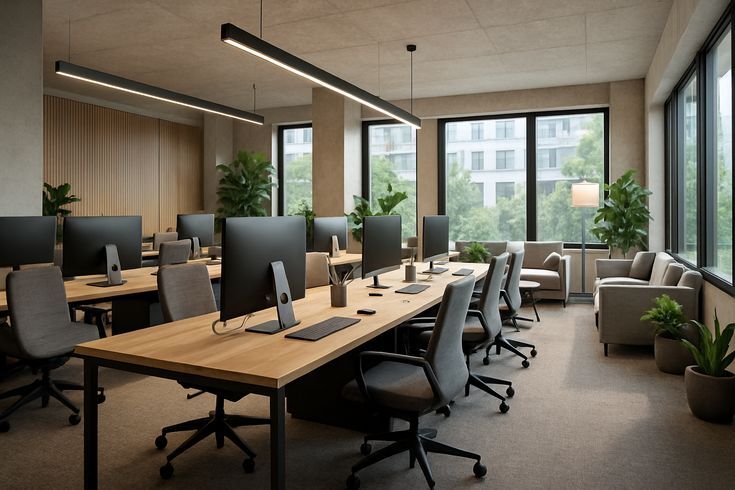
Startups don't have to wait weeks to fill an empty commercial property; they can occupy a full-ready office space that has desks, internet access, common areas, meeting rooms and basic office equipment.
This lowers the initial investment necessary to get a business up and running in a business office.
Pay only for the space you require.
Startup companies don't usually have a clear picture of how many people they'll have in the company six months, or even a year, later.
As a result, having a large traditional office might involve paying for unused space when the business has just begun.
Coworking spaces enable businesses to choose the workspace based on their requirements. Depending on the needs of the freelancer or the small startup, a single working desk or a private cabin and/or dedicated work area may be necessary.
It can sometimes be possible to expand the workspace as the business expands without having to find and set up a completely new office.
Reduce the cost of furniture and infrastructure.
Establishing a traditional office needs furniture, including desks, chairs, storage units, reception furniture and meeting tables.
The following are usually part of the workspace in Coworking spaces:
Startups can thus avoid taking a hefty hit in the beginning on office furniture, before they have a regular income flow.
By using the Shared Facilities, costs are minimized and you can save money every month.
One of the benefits too is the sharing of facilities.
Startups can benefit from the resources the coworking operator can provide, rather than paying for each of the above individually.
This combination allows businesses to share the expense of office infrastructure and thereby allow smaller businesses to access professional office facilities.
One of the best ways to help startups manage cash flow is with flexible plans.
The initial stages of a business are very important because of cash flow.
A long term commercial lease can be a burden on a start up business when, for example, their business changes direction or staff numbers increase or decrease.
Co-working spaces typically offer more flexible workspace options. Instead of investing a huge part of their budget in a long-term workspace, startups can opt for a space that is suitable for their current requirements.
This flexibility can help to simplify months of budgeting.
The Coworking Space in HSR Layout is the perfect solution for businesses that are going through a growth phase.
The other factor that cannot be ignored in terms of workspace selection is the location.
HSR layout is one of those areas where startups, freelancers and professionals have found it convenient to settle down and make a business.HSR layout has emerged as a popular choice for business and residence for startups, freelancers and professionals.
A co-working space in HSR layout can provide businesses with a professional workspace while ensuring that they are not too far from major areas like Koramangala, BTM layout and Electronic city.
HSR Layout near South Bangalore may be a feasible place for startups where staff and/or clients are based.
If you need to deal with office maintenance but don't know how to, you are not alone.
Running a conventional office has its own duties, and startups may not wish to deal with them.
Office management can be time and money consuming, from arranging repairs to maintenance of common areas, housekeeping and internet systems, etc.
Many of these tasks are taken care of by the co-working provider.
This lets the startup founders and their teams focus on the business and less on office administration.
Meeting Rooms Without Keeping a Meeting Room Full
Not all startups require a specific conference room every day.
But for client meetings, client interviews, presentations and team meetings, you still need a professional environment.
Businesses can also make use of meeting rooms that are often offered by a coworking space when required. Then a start-up company doesn't have to take up significant office space in a large conference room.
Industry's Top Workplace Without a High Price Tag!
A professional environment can be a difference when it comes to client meetings, candidate interviews, and business partners.
Rather than spending significant resources on a high-end office, startups may take advantage of a coworking space which supplies professional workspaces and necessary business facilities.
This can enable smaller businesses to make a good impression without overspending on infrastructure.
Coworking vs Traditional Office: A Simple Comparison
| Expense | Traditional Office | Co-working Space |
| Security deposit | Usually required | Depends on plan |
| Furniture | Startup investment required | Generally provided |
| Internet setup | Separate expense | Usually included |
| Meeting room | Dedicated space required | Shared/available when needed |
| Maintenance | Business responsibility | Usually managed by provider |
| Housekeeping | Separate arrangement | Generally provided |
| Office expansion | Requires relocation/setup | Easier to scale |
| Initial setup | Higher | Lower |
Costs will depend on the location, workspace model, team size and provider, but the coworking model can lower capital investment needed to open an office.
Does Coworking fit into every startup?
Coworking might not be the ideal solution for all businesses.
A private office may be more advantageous for companies that have a large staff, special equipment, privacy needs, or office configurations.
But, when it comes to startups, freelancers, small businesses, and expanding teams, coworking can be helpful in terms of cost, flexibility, and professionalism.
To choose the appropriate work environment.To select the appropriate working space.
Startups need to assess more than the monthly fee when they consider using a coworking space.
Take into account where it is, how reliable the internet is, the space of the workspace, the privacy, and the availability of meeting rooms, parking, security, power backup and working hours amongst other options.
It is also crucial to see the services that are covered by the monthly cost and if any extra fees are required for conference rooms, printing, parking, or other services.
Final Thoughts
Start-ups can find their office costs to be a significant issue, particularly during times when they are establishing their presence.
One benefit to a coworking space is that it can save you money on the startup costs and upkeep of a standard office. In contrast to making significant investments in infrastructure, startups can opt for a “plug and play” environment and put more of their funds towards business expansion.
A good alternative option for businesses looking for an office space in Bangalore is coworking. For South Bangalore startups, a coworking space in HSR layout may offer a convenient location, with the flexibility required during the initial growth stages.
In the end, the ideal workspace is the one that suits your existing team, budget and business plans and will provide you with space for expansion.
FAQs
1. How does coworking help startups save money?
Coworking can reduce expenses related to office setup, furniture, internet infrastructure, maintenance, housekeeping, and other shared facilities.
2. Is coworking cheaper than renting a traditional office?
For many small startups and early-stage businesses, coworking can be more cost-effective because the workspace is already furnished and many operating costs are shared.
3. What should I consider when choosing office space in Bangalore?
Consider location, rent, workspace type, amenities, internet, meeting rooms, parking, security, power backup, and flexibility before making a decision.
4. Why choose a coworking space in HSR Layout?
HSR Layout offers convenient access to several important business and residential areas in South Bangalore, making it a practical location for startups and professionals.
5. Can a startup move from a shared workspace to a private cabin?
Yes. Many coworking providers offer different workspace options, allowing businesses to move from shared seating to private cabins or larger offices as their teams grow.